
Everything you Need to Know About Lemons
The origin of the lemon is unknown, though lemons are thought to have first grown in Assam (a region in northeast India), northern Burma or China. A genomic study of the lemon indicated it was a hybrid between bitter orange (sour orange) and citron.
Lemons entered Europe near southern Italy no later than the second century AD, during the time of Ancient Rome. However, they were not widely cultivated. They were later introduced to Persia and then to Iraq and Egypt around 700 AD. The lemon was first recorded in literature in a 10th-century Arabic treatise on farming, and was also used as an ornamental plant in early Islamic gardens. It was distributed widely throughout the Arab world and the Mediterranean region between 1000 and 1150.
The first substantial cultivation of lemons in Europe began in Genoa in the middle of the 15th century. The lemon was later introduced to the Americas in 1493 when Christopher Columbus brought lemon seeds to Hispaniola on his voyages. Spanish conquest throughout the New World helped spread lemon seeds. It was mainly used as an ornamental plant and for medicine. In the 19th century, lemons were increasingly planted in Florida and California.
In 1747, James Lind’s experiments on seamen suffering from scurvy involved adding lemon juice to their diets, though vitamin C was not yet known.
The origin of the word lemon may be Middle Eastern. The word draws from the Old French limon, then Italian limone, from the Arabic laymūn or līmūn, and from the Persian līmūn, a generic term for citrus fruit, which is a cognate of Sanskrit (nimbū, “lime”)
The great thing about lemons are that you can pretty much use the whole fruit, whether you’re grating a little lemon zest onto a dish for an addition of intense lemon flavor, or using the juice, which has a wonderful sharp, sour taste. Though they are too tart for out-of-hand eating, adding the juice and zest is a beautiful way to flavor a diverse range of dishes, including seafood, salad dressings and desserts.
There are two main lemon varieties. Eureka lemons are the most common, and are the lemon variety sold in retail stores. Meyer lemons are milder and are often grown on a smaller scale. Other lesser known varieties include the Bonnie Brae, the Femminello and the Yen Ben.
Eureka Lemons
The ‘Eureka’ grows year-round and abundantly. Eureka lemon trees grow about 10 to 12 feet tall and are more wide-spreading the Meyers. This is the common supermarket lemon, also known as ‘Four Seasons’ (Quatre Saisons) because of its ability to produce fruit and flowers together throughout the year. This variety is also available as a plant to domestic customers. There is also a pink-fleshed Eureka lemon, with a green and yellow variegated outer skin.
A rose by any other name might smell as sweet, but a lemon by any other name will not taste as sweet. There is a huge difference between the Meyer lemon and the Eureka lemon, in both appearance and taste.

Meyer Lemons
The Meyer lemon (Citrus × meyeri), is a hybrid citrus fruit native to China. It is a cross between a citron and a mandarin/pomelo hybrid distinct from the common or bitter oranges.
Mature trees are around 6 to 10 ft (2 to 3 m) tall with dark green shiny leaves. Flowers are white with a purple base and fragrant. The fruit is rounder than a true lemon, deep yellow with a slight orange tint when ripe, and has a sweeter, less acidic flavor.
It was introduced to the United States in 1908 by the agricultural explorer Frank Nicholas Meyer, an employee of the United States Department of Agriculture who collected a sample of the plant on a trip to China.
The Meyer lemon is commonly grown in China in garden pots as an ornamental tree. It became popular as a food item in the United States after being rediscovered by chefs such as Alice Waters at Chez Panisse during the rise of California Cuisine starting in the 1970s. Popularity further climbed when Martha Stewart began featuring them in her recipes.
Bonnie Brae
The ‘Bonnie Brae’ is oblong, smooth, thin-skinned, and seedless. The Bonnie Brae was a popular variety of lemon in the late 1800s through early 1900s that was first cultivated in Bonita, California, near San Diego. Although no longer produced commercially, trees can be found California.
Femminello
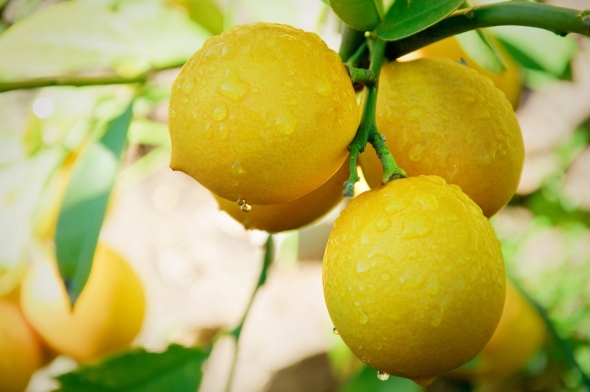
The ‘Femminello St. Teresa’, or ‘Sorrento’ is native to Italy. This fruit’s zest is high in lemon oils. It is the variety traditionally used in the making of limoncello.
Yen Ben
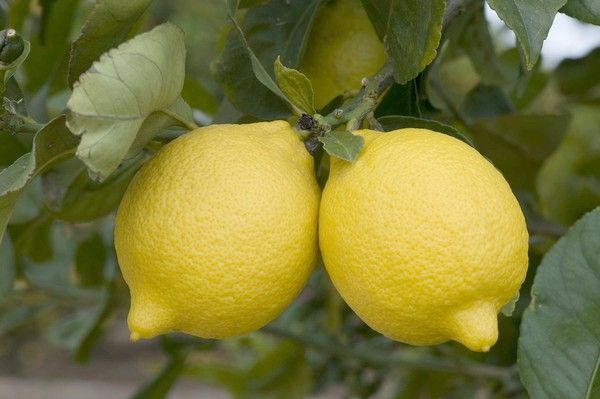
The Yen Ben (Citrus × limon) was first grown in Australia and has been a popular lemon to grow in New Zealand since the 1970s. It’s smooth and thin rind with very few seeds and high percentage of juice makes it easy to use and rewarding in the kitchen. Yen Ben is a winter-producing lemon, though produces multiple crops throughout the year with the majority of fruit harvested in winter. For successful growing and fruiting, plant in a large container or tub so it can enjoy maximum warmth and sunshine Protect from cold strong winds, and hard winter frosts.

The Meyer lemon (left) is a hybrid of a mandarin and a lemon. The hardiest citrus in New Zealand, it is popular with home gardeners. The Yen Ben (right) is a true lemon and the main variety grown commercially in New Zealand. It has a smooth, thin skin and few seeds.
How to Select and Store Lemons
Choose lemons that are firm and heavy for their size, with a close-grained, slightly glossy yellow peel. To tell if a lemon is heavy for its size, pick up two lemons at once and go with the heavier lemon. Avoid wrinkled fruits as well as those with hard or soft patches, or with a dull or excessively yellow peel, as these are all indications that the fruit is no longer fresh.
They can be stored at room temperature for up to one week, or in the fridge inside a plastic bag for 2-3 weeks.
How to Prepare Lemons
How To Zest a Lemon: The zest of a lemon is the yellow part of the skin, it has an intense lemon flavor. If you are using the zest (skin) of a lemon, first wash it under cold water and use a scrub brush to wash away any dirt or debris. Then dry before zesting. A fine grater, sometimes called a zester is the easiest way to remove the zest. But, you can also use a vegetable peeler to remove sections of the peel, then slice or mince it.
How To Juice a Lemon: Before juicing a lemon, roll the lemon on a flat surface to soften it. The easiest way to extract the juice of a lemon is to twist the lemon half on a reamer (juicer), but a fork works just as well.
If you’re serving a dish with lemon slices, try to remove most of the seeds. It will make it easier for your guests.
How to freeze lemons: Both the juice and the zest of lemons can be frozen. The candied or dried zest should be placed in an airtight container and stored in a dry and cool place.
How Much Juice Does 1 Lemon Hold?
One lemon should yield approximately 2-4 tablespoons of juice.
Tips
•The zest of a lemon adds amazing flavor to dishes, but the inside white part is bitter. Use a zester to remove the zest to add the essence of lemon to a dish without the tartness. If you don’t have a zester to remove the zest from a lemon, use a peeler, or a fine grater. Peel the skin, then finely cut in into strips, and then mince.
•Before juicing a lemon, roll it on the counter under your palm, while adding a little pressure. This will soften up the lemon and make it easier to juice.
•To tell if a fruit is heavy for its size, pick up two and choose the heaviest one.
•Always zest your lemon before you cut it, as it is very difficult to zest it after it has been cut!
•If you don’t have a reamer to juice a lemon, a fork will do the trick.
•To help get the most flavor from lemon juice when adding to recipes, try to squeeze the lemon so the juice runs over the outside of the peel. This helps to release the oils from the peel to intensify the flavor!
What Goes Well With Lemons?
Because of their acidity, lemons goes well with: capers, fish, garlic, shrimp, lobster, Mediterranean cuisine, basil, honey, coconut, chicken, ricotta and goat cheese as well as blueberries and blackberries.
Serving Ideas
Lemons can serve both decorative and culinary purposes. They are a popular flavor enhancer, and a good substitute for salt. They also prevent some fruits and vegetables from discoloring. Lemons add zest to soups and sauces, vegetables, cakes, custards, ice creams, and sorbets.
Lemon juice may replace vinegar in dressings and is also used to marinate and tenderize meat, poultry, fish, and game.
The zest of lemons can be grated or sliced and is available candied or dried. It is often used to flavor meats, sauces, and desserts.
Adding a squeeze of lemon to your water is a healthy way to zest up your hydration habits.
Nutrition
Like all citrus fruits, lemons are very rich in vitamin C, providing 64% of the Daily Value in a 100 g serving . They are also a good source of potassium and folic acid.
Lemons also contain numerous phytochemicals, including polyphenols, terpenes, and tannins. Lemon juice contains slightly more citric acid than lime juice (about 47 g/l), nearly twice the citric acid of grapefruit juice, and about five times the amount of citric acid found in orange juice
Sources
Gulsen, O.; M. L. Roose (2001). “Lemons: Diversity and Relationships with Selected Citrus Genotypes as Measured with Nuclear Genome Markers”. Journal of the American Society of Horticultural Science. 126: 309–317.
Lind, James. (1757). A treatise on the scurvy. Second edition. London: A. Millar.
Morton, Julia F. (1987). “Lemon in Fruits of Warm Climates”. Purdue University. pp. 160–168.
Produce Made Simple: Lemons (2019) The Ontario Produce Marketing Association. Date Accessed February 2, 2019. https://producemadesimple.ca/lemon


You must be logged in to post a comment.